Every business owner and entrepreneur wants to cut down on waste and save more on time and material. That’s a given.
Why look into the technology of precise grinding of tungsten electrodes?
Superior performance is just the beginning
Every business owner and entrepreneur wants to cut down on waste and save more on time and material. That’s a given.
In the metal working and welding industries, our first instinct is to analyze the major steps of the production process and optimize these with better equipment.
What is often overlooked are the smaller steps of the production process. Thing is, they add up to a bundle and have a major impact on your business’ financial health every year.
They help you save smaller amounts of time and resources but can lead to major savings.
One of those smaller steps is the grinding process of tungsten electrodes.
With a few key adjustements, it can help you reach that extra profit you were looking for.
Before reading more … you may ask your self:
HOW MANY TUNGSTEN ELECTRODES
DO YOU USE EVERY YEAR?
Enjoy the reading!
Anders Thy
Owner & Managing Director
Inelco Grinders A/S
The art of precise Grinding
A tungsten electrode is a lead actor in the TIG welding process. Before every weld, comes the necessity of assuring a correct tip geometry. Proper geometry is essential to obtain a stable arc and get optimalwelding performances, and often requires a grind or a regrind of the tip.
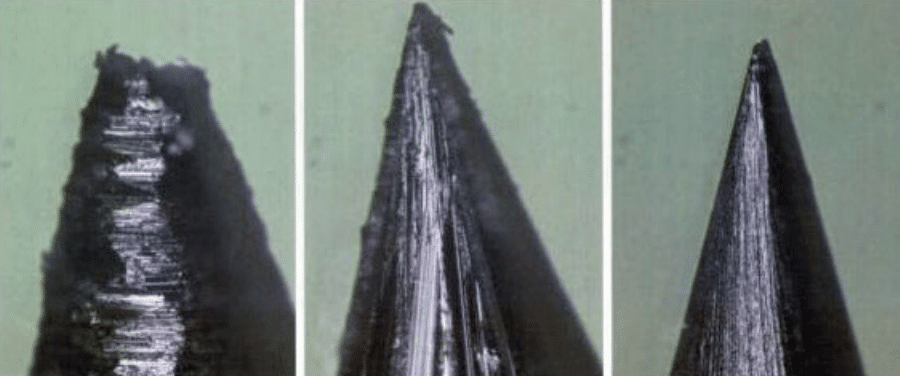
Grinding a top angle on the tungsten electrode is a precision job. The angle can vary from 15 to 180 degrees. The grinding grooves should run in the longitudinal (axial) direction of the tungsten electrode and never around the tungsten electrode (radial). A tungsten electrode with the grinding grooves around the tip will hardly ever have a stable arc. The arc searches for the places with the lowest resistance on the grinding grooves and will therefore rotate around the tip of the tungsten electrode.
Maintaining the properties and molecular structure ofthe tungsten electrode is imperative for the correct functionning of the electrode when welding. It is therefore important to prevent an eventual oxidation (production of oxides) on the surface of the electrode when grinding it. Keeping the temperature low is best assured by using a liquid coolant.
Knowing that grinding also causes friction, and thereby heat, it is also of interest to reduce the time of grinding by using a dedicated diamond wheel. It is then possible to obtain a well preserved ground electrode with a smooth and even surface with a polished finish for an optimal performance.
When TIG welding, several variable parameters like amperage, arc length, gas flow, travel speed etc. all have an influence on the end quality of the weld. The tip angle of the tungsten electrode is often a neglected factor and left out of this list. However, in order to obtain a consistent quality, is it important to have as many of these parameters to be constant, including the tip angle of the tungsten electrode being used. Having the adequate angle according to the application, assures the optimal performance of the tungsten electrode as well as reduces the amounts of regrinds necessary and thereby enhances efficiency.
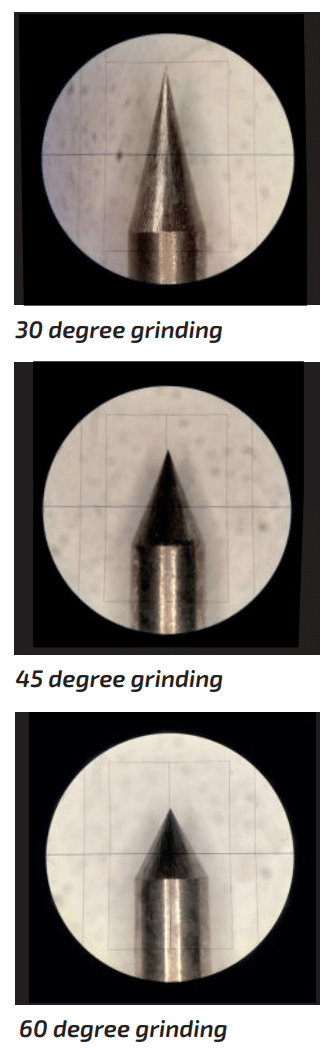
Precise angle of the electrode
It is important that the grinding grooves are as small as possible. Deep grinding grooves cause energy loss and unstable arc behaviour.
Never grind tungsten electrodes on a belt grinder, flap disc or deburring disc. You will not be able to grind a good quality point on the tungsten electrode on these devices and adhesive residues from these products will deposit on the tungsten
electrode, making the starting procedure worse. In the worst case, some of these contaminants will drop into the weld pool and polute it, which is of course unwanted.
We can understand that practice is sometimes different from theory, but if you want to do good quality work, the aforementioned grinding devices are not suitable for grinding tungsten electrodes.
When grinding, not only make sure that you have very fine grinding grooves, but also prevent discoloration during grinding of the tungsten electrode. This discoloration indicates the tungsten electrode has been too hot and oxide has formed on the surface which will cause poor ignition of the arc. Grind
tungsten electrodes preferably on dedicated diamond discs. This gives a very fine surface to the tip and arc stability.
It is important, especially with automated TIG welding, that the tip is centered on the tungsten electrode.
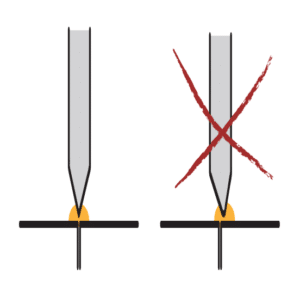
Consistency in grinding the electrode
Working with an open belt or bench grinder lacks precision. The welder will need more attempts to get the correct geometry required for the weld. With every regrind comes a loss of app. 1mm-2mm.
Using an angle adjustment and clamping system centres the electrode, so that the grinding is carried out in the desired angle and correct longitudinal direction of the electrode. A precise angle is not only important for the quality of the welding seam; the number of reignitions between regrinding is also increased.
The key word here is CONSISTENCY. It is a fact that conventional and manual grinding cannot provide uniform and consistent grinding of tungsten electrode. For that you will need proper grinding equipment.
Short electrodes often get thrown out to avoid hand injuries. Using an electrode holder will not only be a much safer solution, but will also allowthe welder to grind electrodes to a much shorter length and with much more precision.
Avoid handgrinding and work with precise angle setting
If you avoid any handgrinding process, you will already avoid waste due to imprecision and countless guessings. Work with a tungsten grinder on which you can easily set a precise grinding angle and obtain the needed geometry the first time you grind your electrode and every time after that.
The tungsten grinder your welders work with should allow them to safely and efficiently regrind their tip after a dip. Open belt or bench grinders can allow them to do that, but will cause dust inhalation and hazardous situations.
Precision in manual TIG welding
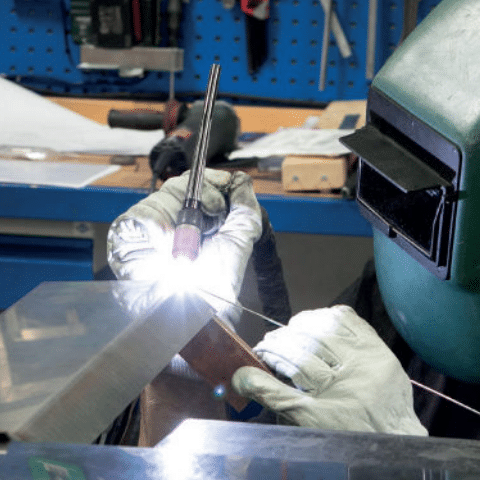
When TIG welding manually, there is always a certain lack of precision, because ofthe human factor. In this case, the ”precision” refers to the consistency of the grind, the ease of a precise grind, the safety of the grind, the ease of arc ignition and the stability of the arc.
The human factor is binary: it can cause variations but also adaptation. Parameters like travel speed, arc length and amperage are not constant during the process, because of the instability of the hand that welds.
Precision in orbital TIG welding
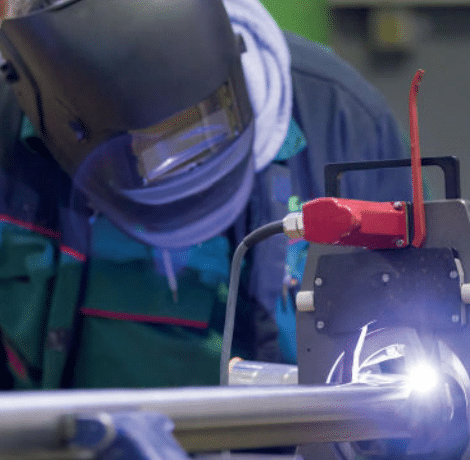
Orbital welding is more precise than manual welding, since it is performed by a machine.
Parameters such as arc length, travel speed and amperage are constant during the welding process. There is no possibility of adjustment during the process, therefore, a precise and correctly ground electrode is of high importance so as to assure an easy ignition and a stable arc is essential for obtaining the correct welding result.
Precision in automated TIG welding
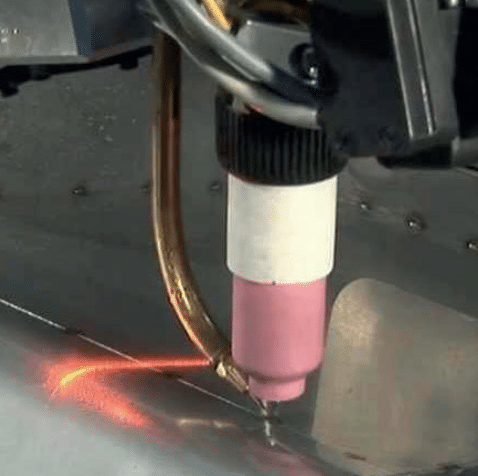
When working with automated TIG welding processes, everything has to be perfectly planned in advance, because of the autonomy of the entire process.
Sometimes an automated TIG process is a very complex process built up of several small sub-processes. This calls for excellent quality in each step, including a consistent grinding angle, a flawless ignition and a stable arc.
Facts of waste
Waste from throwing out short electrodes
The average length of an electrode is between 150mm and 175mm and most often, a welder will throw it out when it reaches 50mm in length. This means that more than 25 % of the electrode will never be put to use.
Waste from lack of precision
Working with an open belt or bench grinder lacks precision. The welder will need more attempts to get the correct geometry required for the weld. With every regrind comes a loss of app. 1mm-2mm. If we estimate eight regrinds per day that gets us to 16 mm and up to 10-15 % of the electrode.
Waste from breaking off the tip after dip
When a welder dips the electrode in the weldpool, they often break off the tip of the electrode to remove the ball of material stuck on it. There’s an average loss of 10mm. If we set the average dip frequency to twice per day that gets us to 20 mm and up to 13 % of the electrode. These numbers vary greatly from one business to the next depending on the cost per electrode, amount of regrinds, amount of dips and other data, but an estimate of 20 to 50% waste turns out to be the experienced case for many.
What if there was a way to save up to 50% on tungsten electrodes every year?
A tungsten electrode is a lead actor in the TIG welding process. Before everyweld, comes the necessity to grind the tungsten electrode. Proper geometry is essential to obtain a stable arc and get optimal welding performances.
A TIG welder might use one electrode every week, and there might be more than one welder on yourteam. The cost for a pack of 10 tungsten electrodes varies between 10 and 100 euros, according to the type and manufacturing of course.
If a business uses 10 electrodes per week and the cost for these is 3 euros/each, their total expense in electrodes will be around 1,500 euros/year.
Most of that money spent on tungsten electrodes is wasted during the grinding process, for multiple reasons :
- Tungsten electrodes get thrown out when they get an average of 50 mm
- The grinding lacks precision and therefore requires multiple attempts
- The tip of the electrode is cut before it is being ground again.
You may ask your self:
HOW MANY TUNGSTEN ELECTRODES DO YOU BUY EVERY YEAR?
3 QUICK WINS TO SAVING MONEY
Stop throwing out short electrodes
Ultima-TIG allows you to precisely grind short electrodes (as short as 8mm for orbital welding).
You can save up to 20% of your tungsten electrode
Stop useless regrinds
Precise settings prevent countless regrinds. And with every regrind, Ultima-TIG will only use 0.3mm of electrode, whereas the handgrinding process can waste up to 2mm per regrind.
You can save up to 15% of your tungsten electrode
Stop cutting the tip after dip
You can insert your electrode in the electrode holder and grind it with Ultima-TIG right after a dip to avoid cutting part of the electrode*. It can quickly be ground with the same precise settings you previously used *).
You can save up to 15% of your tungsten electrode
*Depending on the extent of the dip/damage, sometimes a cut is necessary
and unavoidable.
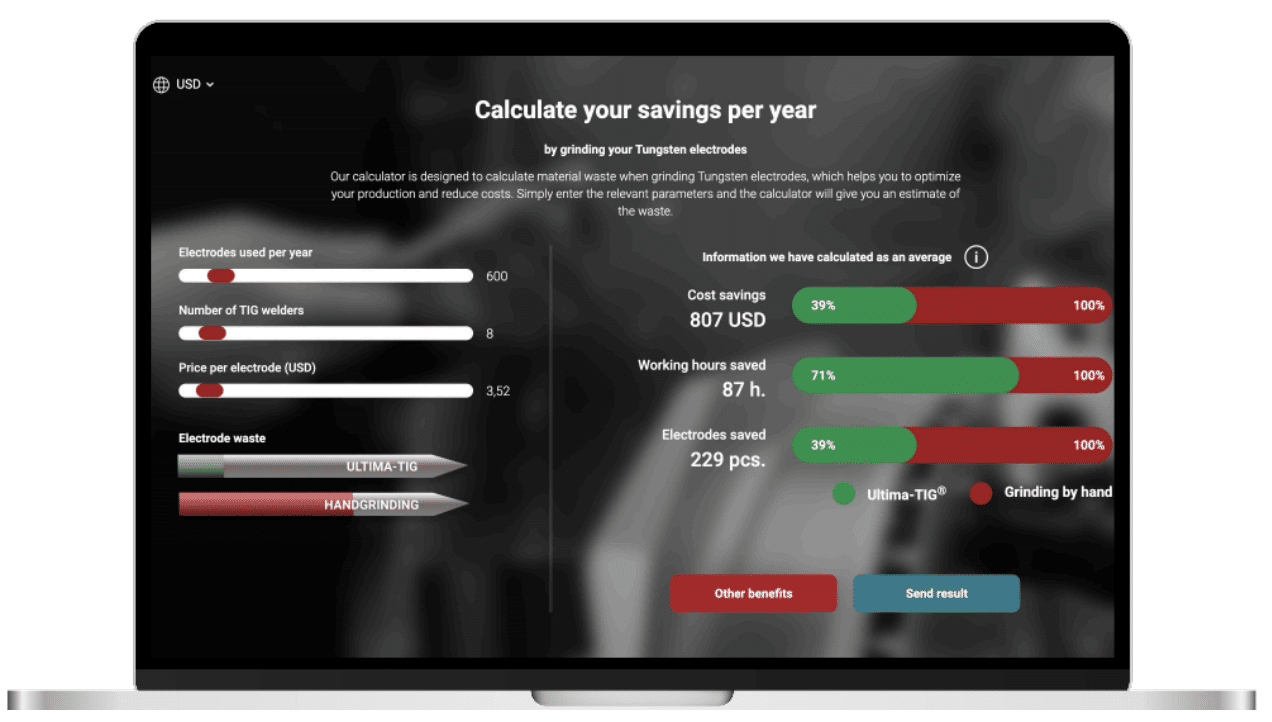
Calculating waste is made easy with our calculator
This calculator can determine the savings in tungsten electrodes one can achieve if using the Ultima-TIG grinder instead of a hand grinding process with a bench grinder or a belt grinder.
Its efficiency is based on the accuracy of the data provided by the user and on the correct use of the Ultima-TIG grinder. The results will demonstrate the savings that can be made in material costs when using Ultima-TIG, but there are other benefits to its use:
- Less time spent on grinding the electrodes
- Longer time between regrinds
- Better welding results
- Better health and safety conditions for the welder
Would you like to know your savings on Tungsten Electrodes?